

House selling guide
Home Report Scotland: The Complete Guide
A Home Report is the pack a seller must provide before marketing a home in Scotland. It contains a Single Survey with a valuation, an Energy Report and a Property Questionnaire. Most sellers pay between £350 and £800 plus VAT. Private sales to a cash buyer are exempt, so no Home Report is needed.
Written for sellers in Scotland
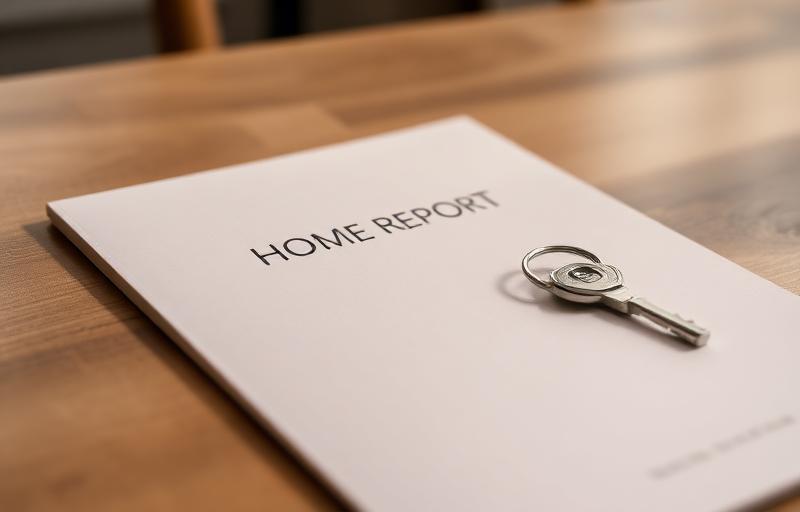
Since 2008 almost every home put on the open market in Scotland needs a Home Report before the first viewing. It is the buyer's first real look at the condition of the property, and the valuation inside it usually sets the price that lenders will work to.
This guide walks through what is inside the pack, what it costs, who does not need one, and what to do when the survey comes back with problems.
What is a Home Report?
A Home Report is a pack of three documents that a seller in Scotland must give to any prospective buyer who asks for it, before offers are made. It was introduced by the Housing (Scotland) Act 2006 and became compulsory in December 2008.
The point of it is to move survey information to the front of the process. Instead of three competing buyers each paying for their own survey, the seller commissions one report that every interested party can read.
- Single Survey: condition, repair categories and a market valuation by an RICS surveyor
- Energy Report: the EPC rating and recommendations for improving efficiency
- Property Questionnaire: a form you complete yourself covering the history of the property
How much does a Home Report cost?
Cost is driven by the value and size of the property rather than the work involved, which is why quotes for the same house vary so much. Always get more than one.
| Property value | Typical Home Report cost |
|---|---|
| Up to £100,000 | £350 to £450 plus VAT |
| £100,000 to £250,000 | £450 to £600 plus VAT |
| £250,000 to £500,000 | £600 to £800 plus VAT |
| Over £500,000 | Quoted individually, often £800 plus |
Step by step
- 1
Check whether you actually need one
You need a Home Report to market a property on the open market. Selling privately, to a family member or directly to a cash buyer does not trigger the requirement.
- 2
Instruct a chartered surveyor
The Single Survey must be carried out by an RICS chartered surveyor on the panel of a recognised provider. Get two or three quotes, because prices vary widely for the same work.
- 3
Complete the Property Questionnaire
You fill this in yourself. It covers council tax band, alterations, parking, flooding history, services and any notices affecting the property. Answer honestly, because errors can unravel a sale later.
- 4
Read the Single Survey carefully
It gives a market value, a repair category for each element (1, 2 or 3) and an accessibility summary. Category 3 items are urgent and will be the first thing a buyer's solicitor raises.
- 5
Decide how to handle the valuation
If the surveyor's figure is below what you hoped for, you can price at the valuation, price above it and expect a mortgage shortfall, or sell to a buyer who is not relying on a lender.
- 6
Keep it current
A Home Report older than around twelve weeks is often refused by lenders. If the property sits unsold you may need a refresh letter or a fresh report.
What to do if the survey flags problems
Repair categories are the part buyers focus on. Category 1 means no immediate action, category 2 means repairs are needed but are not urgent, and category 3 means urgent repairs or further investigation are required.
A category 3 on the roof, damp or wiring will usually cost you either the repair or a price reduction, and sometimes both, because lenders can retain funds until the work is done.
- Get quotes so you can argue about a real figure rather than the buyer's guess
- Fix the cheap, visible items before marketing where you can
- Consider a direct sale when the works are substantial and you do not want to fund them
Selling without a Home Report
A private sale, including a direct sale to a cash buyer, does not need a Home Report because the property is never marketed publicly. That saves the survey fee and, just as importantly, removes the risk of a low valuation reshaping the deal.
Home Report legal checklist
Have these ready before your property goes live, or your solicitor will ask for them anyway.
- Single Survey and valuation from an RICS chartered surveyor
- Energy Performance Certificate (the Energy Report section)
- Property Questionnaire completed and signed by you
- Title deeds and any burdens, servitudes or shared maintenance obligations
- Building warrants and completion certificates for any alterations or extensions
- Gas and electrical safety paperwork where you have it
- Factoring agreement and recent statements for flats
- Council tax band confirmation and any outstanding common repair notices
Frequently asked questions
How much does a Home Report cost in Scotland?
+−
Most sellers pay somewhere between £350 and £800 plus VAT, depending on the size and value of the property. It is payable up front, whether or not the house sells.
Who is exempt from providing a Home Report?
+−
New build properties, right to buy sales, portfolio sales, properties sold off market and private sales such as a direct sale to a cash buyer are all exempt.
What happens if the valuation comes in low?
+−
A buyer with a mortgage can normally only borrow against the surveyor's figure, so a low valuation usually means renegotiation. You can challenge it with evidence of comparable sales, but surveyors rarely move far.
Do I need a Home Report to sell to a cash buyer?
+−
No. A direct sale is exempt, which saves the survey fee and removes the risk of the valuation reshaping your sale.
How long is a Home Report valid?
+−
There is no fixed expiry, but most lenders treat one over twelve weeks old as stale and will want it refreshed.
More selling guides
How Long Does It Take to Sell a House in Scotland?
Average timescales for an open-market sale and how a cash sale compares.
Cost of Selling a House in Scotland
Estate agent fees, legal costs, Home Reports and other selling costs explained.
Cash House Buyer vs Estate Agent
Compare speed, fees, certainty and net proceeds side by side.
Related guides and tools
The cost of selling a house in Scotland
Every fee from Home Report to solicitor, with realistic figures.
Read moreHow long does it take to sell a house?
Stage by stage timescales for a Scottish sale.
Read moreCash buyer or estate agent?
The two routes compared on price, speed and certainty.
Read moreTime to sell calculator
See a realistic range for how long an open market sale takes, and what waiting costs.
Read moreSelling for a particular reason?
Selling in your area
- Sell house fast Glasgow
- Sell house fast Edinburgh
- Sell house fast Aberdeen
- Sell house fast Dundee
- Sell house fast Inverness
- Sell house fast Perth
- Sell house fast Stirling
- Sell house fast Falkirk
- Sell house fast Paisley
- Sell house fast East Kilbride
- Sell house fast Ayr
- Sell house fast Ayrshire
- Sell house fast Hamilton
- Sell house fast Motherwell
- Sell house fast Coatbridge
- Sell house fast Kilmarnock
- Sell house fast Livingston
- Sell house fast Dunfermline
- Sell house fast Kirkcaldy
- Sell house fast Greenock
Get Your Free Cash Offer
We can purchase your property in as little as 28 days, with zero solicitor fees or hassle
